campaign strategy
Pelagic IntelX is a production-grade scrollytelling microsite built as a communications portfolio piece, demonstrating senior-level strategy through a fictional AI ocean plastics company — complete with a real data pipeline (Google Trends, SerpApi, NLP analysis), two integrated campaign concepts, and seven designed PDF collateral documents.
00

problem
Ocean plastic is one of the most documented environmental crises on the planet — and one of the least actionable. Existing data on plastic distribution is fragmented, static, and model-dependent, leaving regulators, researchers, and advocates working from estimates rather than evidence. The result: policy negotiations stall, cleanup efforts misallocate resources, and the public remains disconnected from a problem that is, by definition, invisible beneath the surface.
solution
Pelagic IntelX fuses satellite imagery with a custom computer vision pipeline to produce the first real-time, publicly accessible map of ocean plastic density at planetary scale — turning a chronic data gap into a living, explorable dataset that gives every stakeholder, from UNEP treaty negotiators to environmental journalists, the evidence they've been missing.
A production-grade scrollytelling microsite demonstrating senior-level communications strategy through a fictional AI ocean plastics company, built as a portfolio piece.
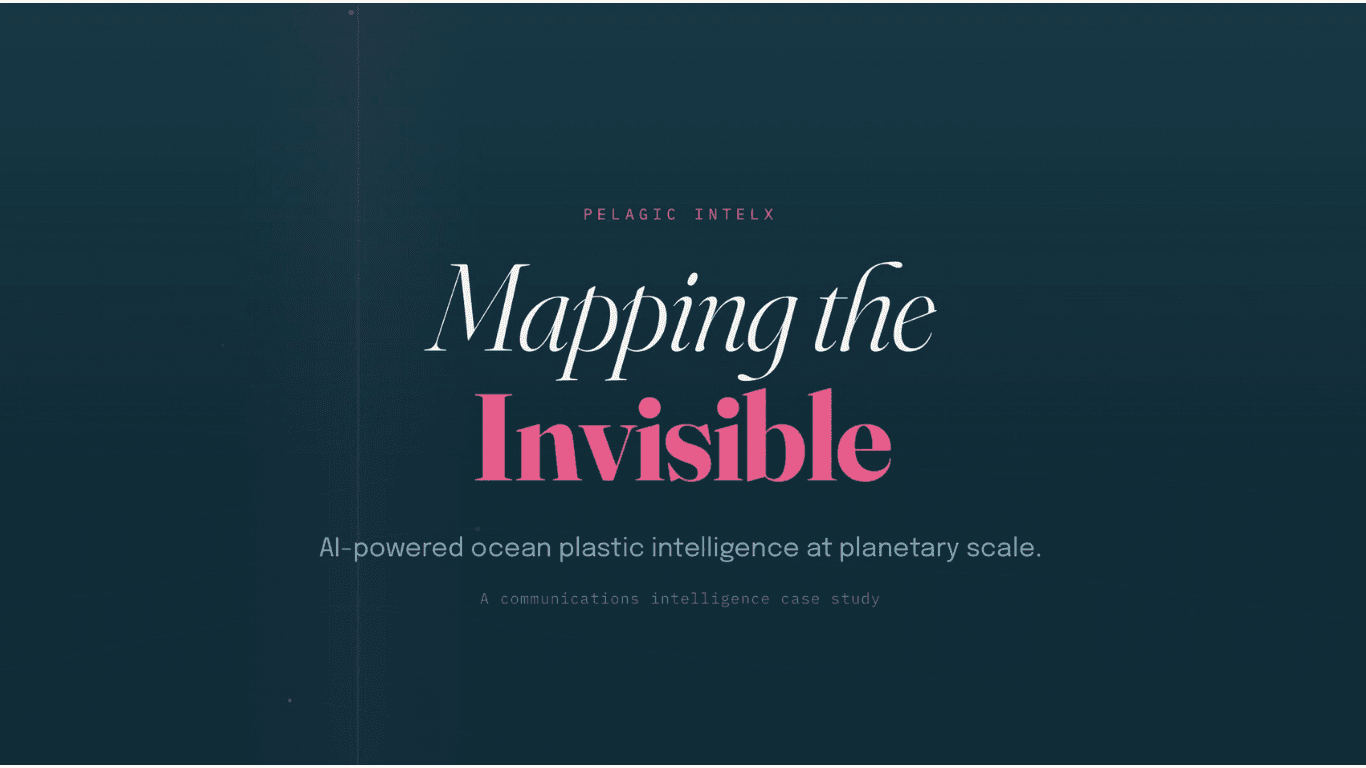
The project follows a five-chapter framework — Signal, Audience, Launch, Impact, Playbook — that demonstrates how a senior communications professional approaches a high-stakes research launch: listening before speaking, segmenting before messaging, and measuring before declaring success.
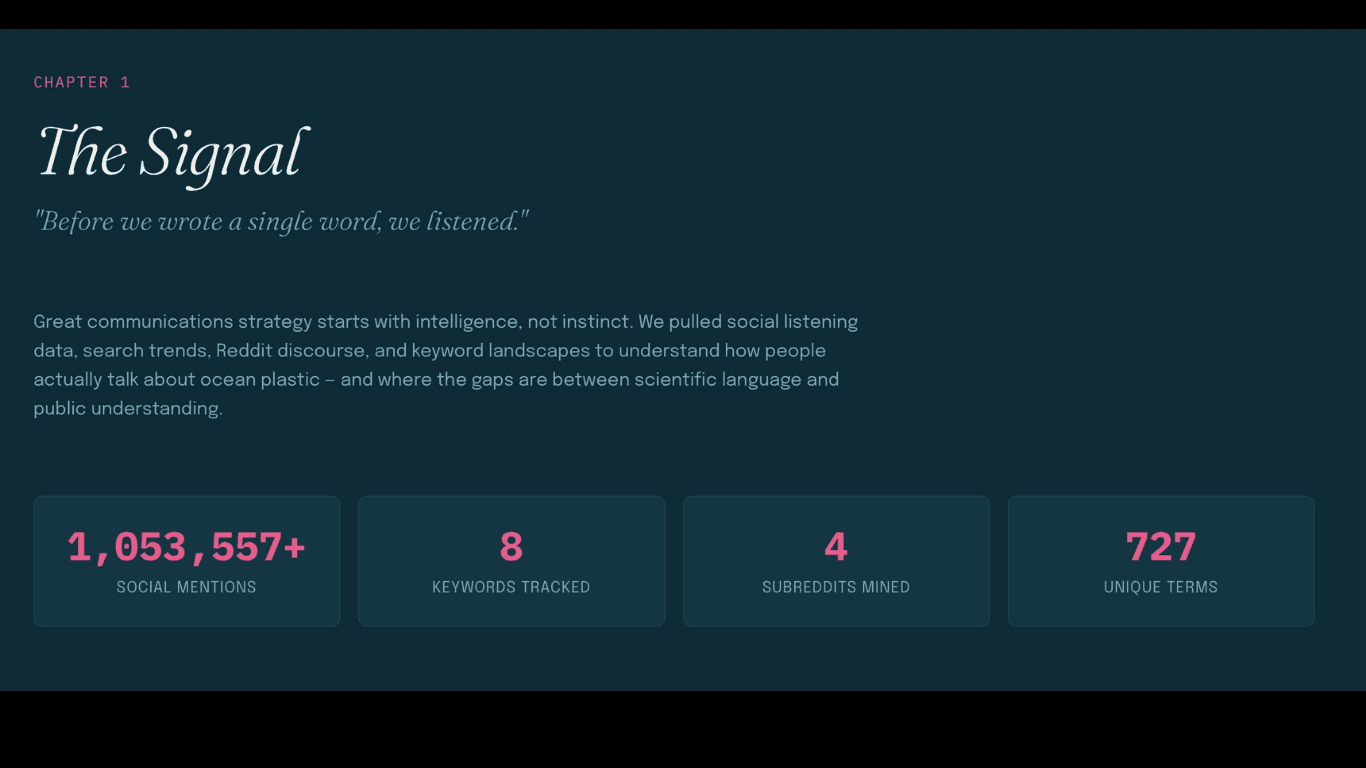
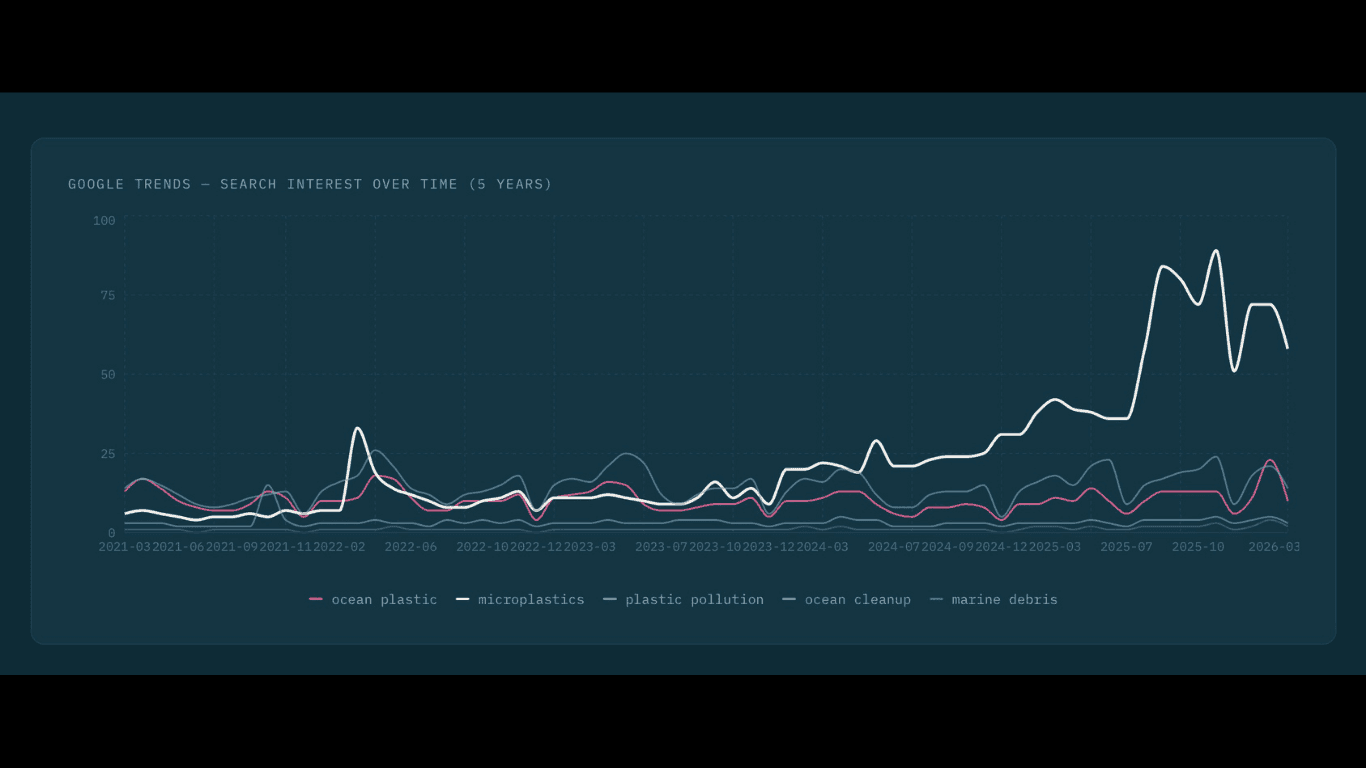
The intelligence layer is grounded in real data. Google Trends (via Pytrends) and SerpApi keyword landscape analysis provided genuine search behavior and SERP intelligence. NLP analysis of a structured Reddit corpus across four subreddits revealed a vocabulary gap ratio of roughly 2:1 — public language consistently outpacing scientific terminology even in informed communities — a finding that directly shaped the message architecture.
The centerpiece of the measurement framework is an original Framing Fidelity Index (FFI): a methodology for tracking how accurately campaign frames survive downstream propagation across press, social, policy, and academic channels. Scored via token-level Jaccard similarity across 2,015 simulated mentions, the analysis found an overall FFI of 34.6% — with policy channels maintaining roughly double the fidelity of social, and short metaphorical frames consistently outperforming technical or quantitative ones.
Tech stack: React + Vite, Scrollama.js, Framer Motion, Tailwind CSS, Mapbox GL JS, Three.js, Recharts, Python (pandas, NLTK/spaCy, Pytrends, SerpApi), deployed on Vercel.
Deliverables
Launch Campaign Collateral
Data Logic
Model Methodology
Media One Pager
Press Release
Social Content Brief
Policy Campaign Collateral
Campaign Strategy Memo
Google Ads Brief
Op-Ed
Stakeholder Matrix


year
2026
timeframe
4 days
tools
SerpAPI, NLP, Google Trends, Python
category
Comm Analytics