histaTrack
A lightweight, mobile-first MVP for Histamine Intolerance, built around load, timing, and threshold
00
problem
Histamine intolerance is hard to manage because reactions are delayed, cumulative, and highly individual. Most people end up guessing: food logs don’t model histamine “stacking,” symptoms don’t map cleanly to a single meal, and common trackers treat every entry as isolated. The result is a frustrating loop of flare-ups, overly restrictive diets, and no clear way to learn what’s actually safe, when, and why.
solution
histaTrack is a lightweight tracking system that models histamine as a dynamic load over time—so users can see how foods, timing, and recovery windows interact to push them above or below their personal threshold. It combines fast meal logging with an explainable “load curve,” symptom notes, and personalized baseline settings (e.g., clearance capacity) to reduce guesswork and help users identify patterns. Built as an MVP with a scalable architecture, future versions expand to support multiple GI conditions and integrate as a layer with tools like MyFitnessPal or Nutritionix.
TLDR: Your body produces histamine naturally and also absorbs it from food. Normally an enzyme called DAO breaks it down fast enough that it never builds up. People with histamine intolerance have reduced DAO activity, so histamine accumulates — and because it's cumulative, a food that's perfectly fine at breakfast can trigger headaches, gut issues, or skin reactions at dinner if the body's "bucket" is already full. That's what makes the condition so confusing: reactions are delayed, stacked across multiple meals, and different every day.
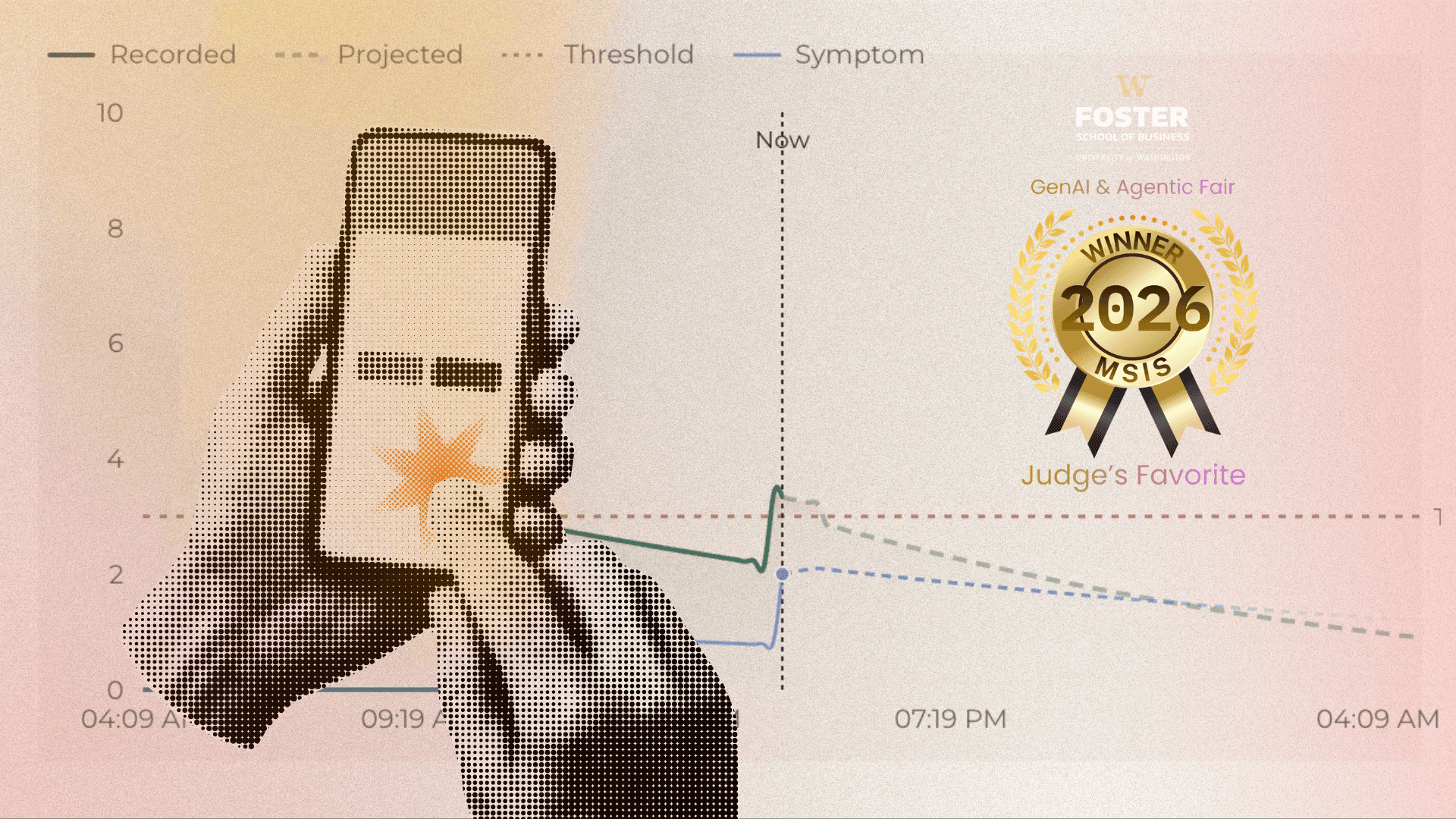
histaTrack is a mobile-first tracking app that models this problem the way it actually works. Instead of a static food diary that labels things "safe" or "unsafe," it calculates a rolling histamine load curve — tracking how meals, timing, food freshness, and DAO-inhibiting factors (like alcohol or certain medications) stack and decay over the course of a day. Users log meals from a library of 1,000+ foods scored by the leading histamine intolerance research group (SIGHI), and the app translates all of that into a simple risk signal so they can make better decisions in real time.
Built in 10 days using React/TypeScript, Supabase (Postgres + auth + edge functions), and Vercel. Won "Judges' Favorite" at the 2026 UW Foster School GenAI and Agentic Fair.
histaTrack is a histamine load tracker designed for people navigating histamine intolerance (HIT) and histamine-related symptoms. Instead of treating food as “good/bad,” it helps users understand the stacking effect of histamine over time — how today’s choices compound with freshness, timing, and individual tolerance.

What the MVP does
Logs food + key context from library of over 1,000 pre-programmed foods (timing, quantity, “DAO inhibitor” windows, etc.)
Models a rolling histamine load curve across the day (decay + accumulation)
Translates that into a simple risk signal so users can make better next decisions
Builds a searchable reaction history so patterns become obvious over weeks, not guesses in the moment
Educates users with FAQ and ‘Learn’ portal
Who it serves
If you’re someone who’s dealt with random flare-ups, confusing triggers, or the “I swear I ate the same thing yesterday” problem — this is built for you. It’s also designed for anyone who wants a more structured, data-driven way to manage symptoms without obsessing over perfect avoidance.
Tech Stack
Frontend: React 18, TypeScript, Vite, React Router, Tailwind CSS, shadcn/ui + Radix UI
State/Data: TanStack React Query, Zod
Visualization & Motion: Recharts, Framer Motion
Forms & UX: React Hook Form, Sonner (toasts), Lucide (icons), Date-fns
Backend: Supabase (Postgres, Auth, Row-Level Security, Edge Functions on Deno), supabase-js v2
Testing & Quality: Vitest, Testing Library, ESLint, TypeScript-ESLint
Deployment & DevOps: Vercel, GitHub
Package/Runtime: npm (package-lock) + Bun (bun.lockb)
Key Engineering Choices
Supabase-first architecture (Postgres + RLS + Edge Functions): Kept the MVP production-shaped from day one—real auth, real data security boundaries, and server-side compute without standing up separate infra.
Edge Functions for “source of truth” compute: Pushed load/risk calculation and food resolution into serverless functions to keep logic consistent across clients and avoid drift.
React Query for data correctness + UX: Cached reads, optimistic patterns where appropriate, and predictable async state management to keep the UI fast while staying consistent with the DB.
Zod + typed contracts: Validated inputs/outputs and reduced “silent failures” in onboarding, logging flows, and compute boundaries.
Component system choice (shadcn/ui + Radix + Tailwind): Built a clean, accessible UI quickly while maintaining consistent design tokens and extensibility for future conditions/features.
Recharts + Framer Motion: Balanced clarity (charts) with delight (micro-interactions) to make time-series health data feel understandable, not clinical.
Methodology
Start with the user pain: delayed/cumulative reactions → tracking must be time-aware (stacking + decay), not a static food diary.
Define an MVP “truth model”: implement a single explainable load curve that updates from events (meals/DAO factors) and decays over time.
Ship end-to-end early: UI → auth → DB → compute → UI loop working before expanding features.
Instrument the workflow, not just screens: designed flows around how people actually log (fast entry, freshness/timing cues, minimal taps) and how they review patterns (day-at-a-glance + history).
Iterate with constraints: prioritized reliability and clarity over “more features,” keeping logic centralized and interfaces stable for future expansions (multi-condition layer, integrations).
Challenges
Modeling delayed, multi-causal symptoms: reactions don’t map to one meal; required a time-based approach and careful UX to avoid false certainty.
Balancing simplicity vs accuracy: an MVP needs fast logging, but HIT management needs nuance (stacking, timing, inhibitors). The design had to feel lightweight without being misleading.
Data quality + consistency: food naming variance and incomplete entries pushed the need for normalization/resolution logic and defensive validation.
Keeping compute aligned across UI + backend: preventing “two versions of the truth” meant pushing core calculations into Edge Functions and enforcing typed contracts.
Secure-by-default requirements: authenticated-only access and RLS policies added complexity but prevented the MVP from becoming a throwaway prototype.
Data
Histamine scoring for the 1,000+ foods in the MVP library was sourced from the leading researcher on Histamine Intolerance, Swiss Interest Group Histamine Intolerance (SIGHI).
year
2026
timeframe
10 days
tools
Lovable, Supabase, Vercel +
category
App Development