The Physiological Shift: Where are you strong?

The Sprint Has a Ceiling
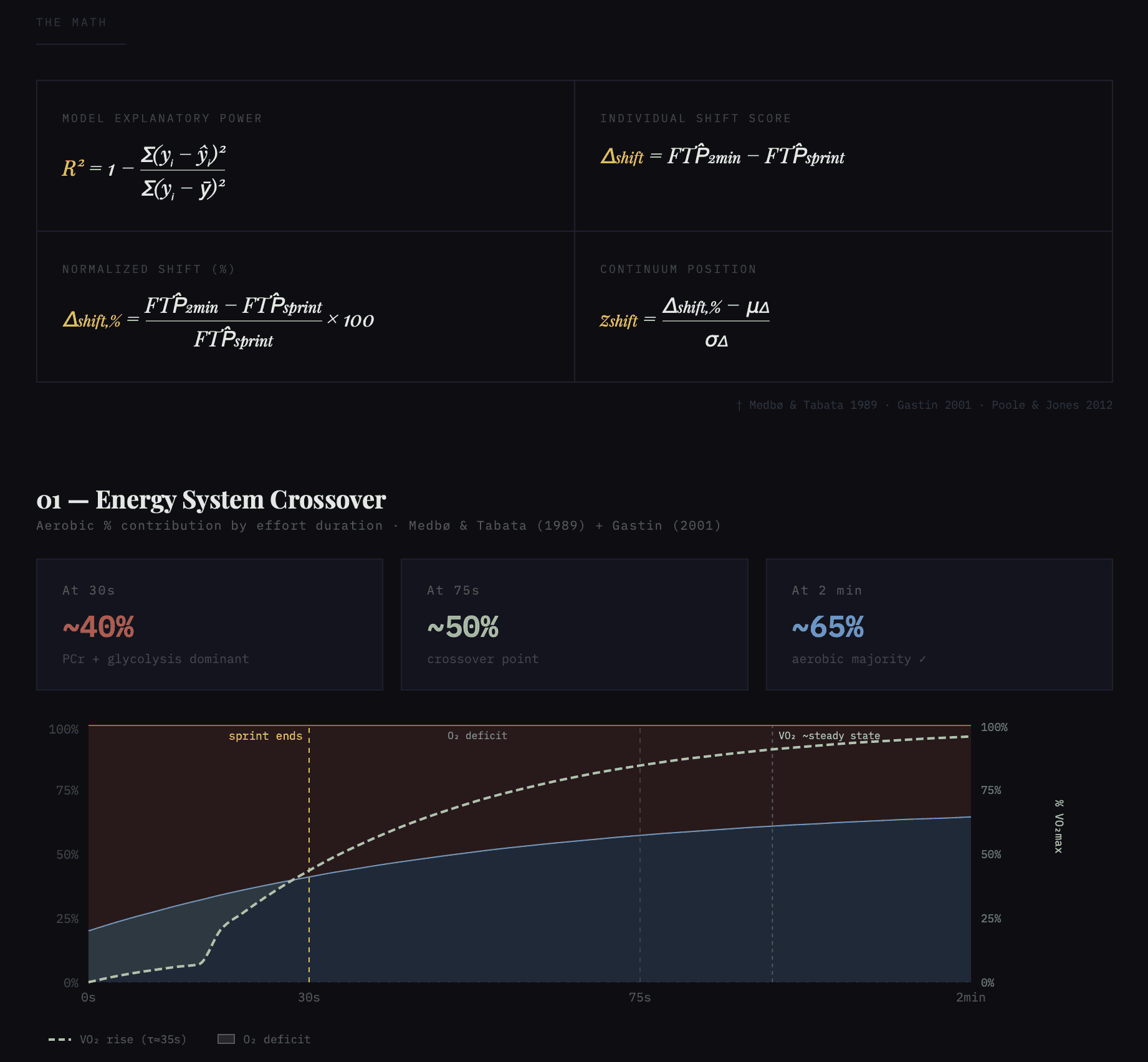
A 30-second sprint tells you something real about a cyclist. It captures neuromuscular peak power, phosphocreatine capacity, and the explosive force-velocity output that decides a field sprint or a criterium attack. Across 4,768 cyclists, that single effort explains roughly half the variance in 20-minute FTP — a meaningful signal, and a hard ceiling. The gap in that ceiling is visible in the chart above: when the sprint ends at 30 seconds, VO₂ is still climbing. The aerobic engine is mid-ignition. The sprint test ends before the system it can't measure has finished turning on.
The Ceiling Breaks at Two Minutes
The ceiling breaks at two minutes. A single 2-minute sub-maximal effort raises FTP prediction accuracy from R²=0.516 to R²=0.704 — an 18.8 percentage point jump, the largest single gain across the entire duration progression. By that point, aerobic metabolism has become the majority ATP supplier (~65%), VO₂ has completed its primary kinetic rise, and the O₂ deficit that accumulated during the sprint has largely resolved. The 2-minute effort and the 20-minute FTP test are physiological neighbors. The 30-second sprint belongs to a different domain entirely.
The Math Is the Prescription
The Athlete Shift Calculator below quantifies what that transition means for you individually. Enter your sprint numbers and your 2-minute power — the shift score reveals the gap between what your neuromuscular output predicts and what your aerobic system actually delivers. A negative shift means your sprint outpaces your oxidative engagement; the aerobic engine needs work. A positive shift means the opposite — your aerobic base is the asset, and your training should leverage it. The math is the prescription.
date published
Mar 9, 2026
reading time
5 min read