Coming Soon: the force-directed stakeholder map

A note from Town Squared Strategies
Inspired by my personal experience in building stakeholder intelligence and strategy in government relations and partnerships. The force-directed stakeholder mapping tool is also a result of my BLOODLINES work.
Public affairs runs on relationships and on the ability to read a room — who is actually in play, where a count stands, whose voice carries and whose only appears to. Most of that lives in people's heads and in hallway conversations. The software that claims to capture it usually can't: it scrapes the public record, calls the result intelligence, and hands you false confidence.
I have been building something narrower, more honest, and more customizable, and I'm getting close to showing it.
The network stakeholder map is a single graph of the actors and relationships that shape an issue — legislators, committees, agencies, advocates, reporters, staff — rendered through a different lens for each of my four service lines. Same actors, same relationships, four ways of looking. It is the methodology underneath everything Town² does, and I'm bringing it out from behind the practice. Multiplying voice, made legible.
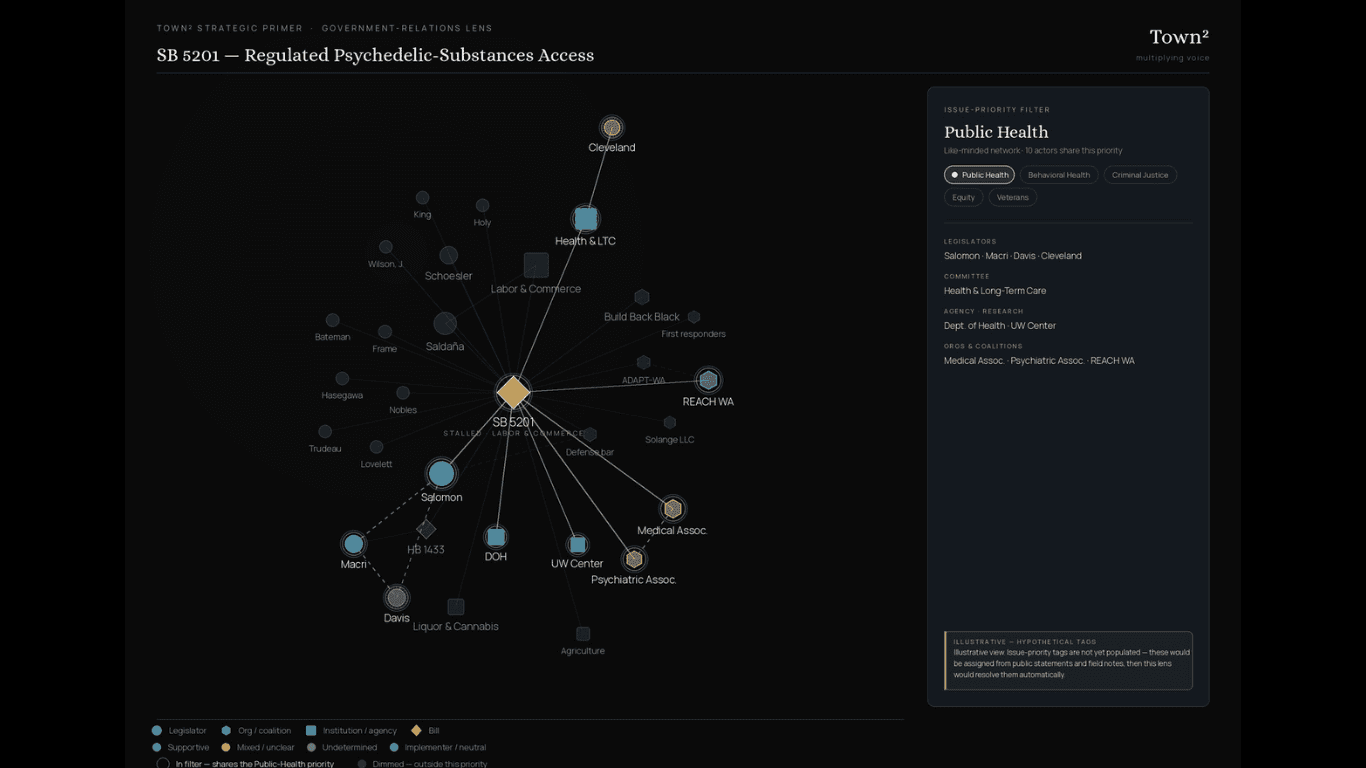
Images for reference only. Actual app user-interface may differ.
The principle it is built on
One rule governs the whole system: never sell a guess as a fact.
Every relationship on the map carries its provenance — public record, inference, or sourced fieldwork — and the map renders those differently so you always know which is which. An insight earned in the room visualizes as earned. A guess seeded from the public record looks like a guess, and it can never quietly promote itself into a conviction it hasn't earned. The map is a set of hypotheses to test, not a set of conclusions to trust. As more data is gathered, it can be flagged persistent or project. Persistent data builds a more robust network and informs future mapping.
The first lens: the Strategic Primer
The government-relations lens ships first, as a tool I call the Strategic Primer.
It renders the Washington State legislative landscape as a navigable network — every legislator a permanent node, with bills, committees, sponsors, testifiers, agencies, lobbyists, and staff overlaid on top. Point it at a bill and a position, and the graph resolves to the work in front of you: who has signaled interest, who sits in the committee holding the bill, where the count stands against the threshold to move it, and where your limited time in the building is best spent. On demand, it writes the prep brief — the same kind of clinical, sourced primer a good staffer would build by hand, in a fraction of the time.
The point isn't to replace the in-person work. It's to do all the knowable homework in advance so that every minute in the capitol goes to what can't be known any other way. Prime, meet, capture what you learned, and the next session's brief is sharper than the last. The gap between where the public record placed a legislator and where your fieldwork has since moved them is the asset the tool exists to build — and it makes that gap visible, so the value of the work is something you can see rather than something you have to assert.
Each Field Note amends the data file with a grounded truth. The map recalibrates and identifies allies, opportunities and risks. It serves as a living strategy doc and CRM.
Under the hood
Framework: Next.js (App Router), TypeScript
Backend: Supabase — Postgres, Auth, Edge Functions, Storage
Hosting: Vercel
Rendering: SVG force-directed network — chosen over Canvas for resilience, native accessibility, and fewer custom subsystems to maintain
Legislative data: LegiScan as the primary source; Washington Legislative Web Services as a conditional fallback
Written briefs: synthesized on demand from the structured graph via the Anthropic API
Provenance model: public / inferred / fieldwork as first-class fields, with database-level constraints that keep an unsourced guess from ever presenting as a firm, sourced read
Sourcing runs on demand, triggered by the work — the tool does not watch the world or pretend to monitor it in real time. It runs the homework when you need it.
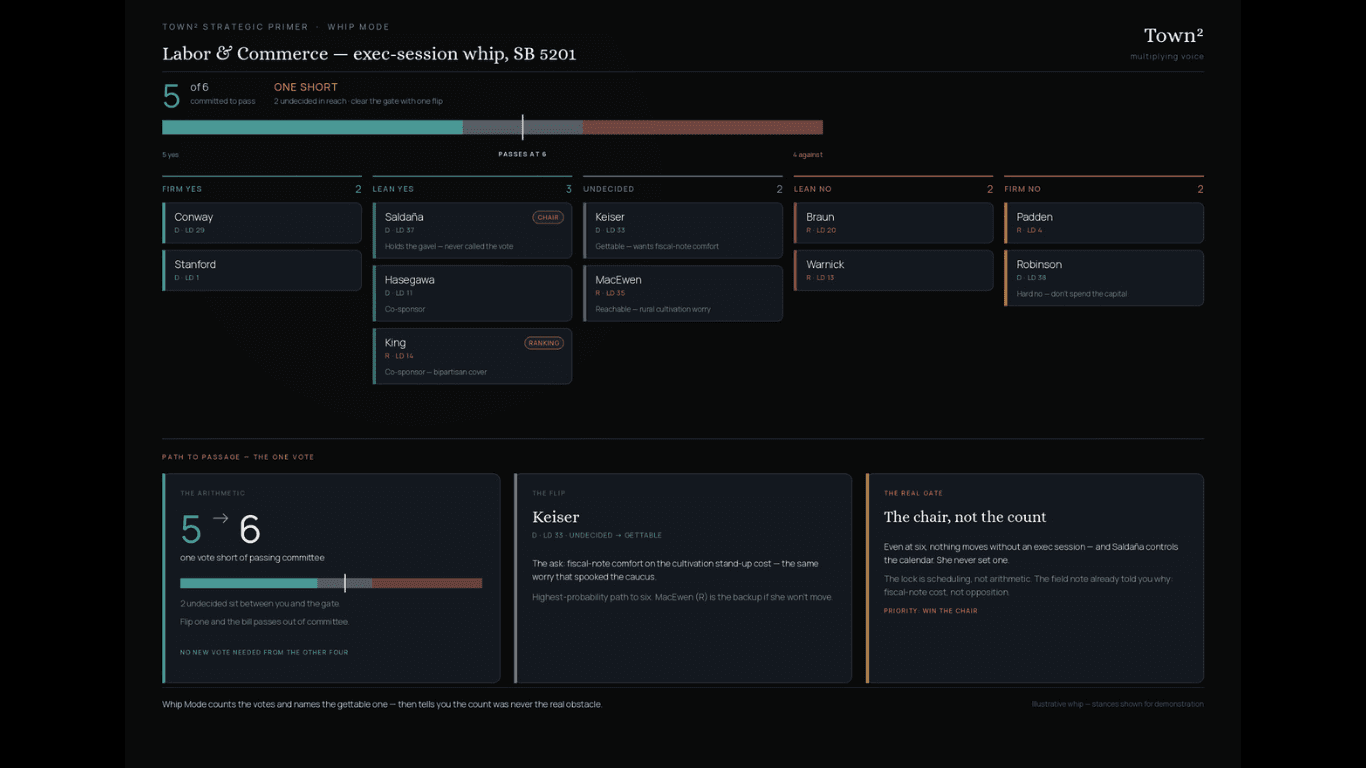
Images for reference only. Actual app user-interface may differ.
Where it applies
The same underlying graph model serves each of the four service lines:
Government Relations — legislative campaign prep: expressed-interest detection, the whip count inside the committee that decides, sequencing your outreach, and the procedural path a bill actually travels.
Strategic Partnership — finding and aligning allies: the coalition around an issue, where shared interest makes a partnership worth building, and how each potential ally connects to one another and to your client.
Communication Analytics — tracking whether a message survives contact with the world: scoring downstream coverage against the frame you set, and finding where fidelity degraded as it moved from actor to actor.
Earned Media — reading the press corps the way we read a chamber: which reporters have carried a frame before, how a given contact is likely to treat a story, and who actually moves it — so a pitch reaches the carrier most likely to keep the frame intact.
The government-relations lens has already been built and validated against a live Washington State Senate bill, and the methodology has been prototyped against issue-coalition and earned-media scenarios.
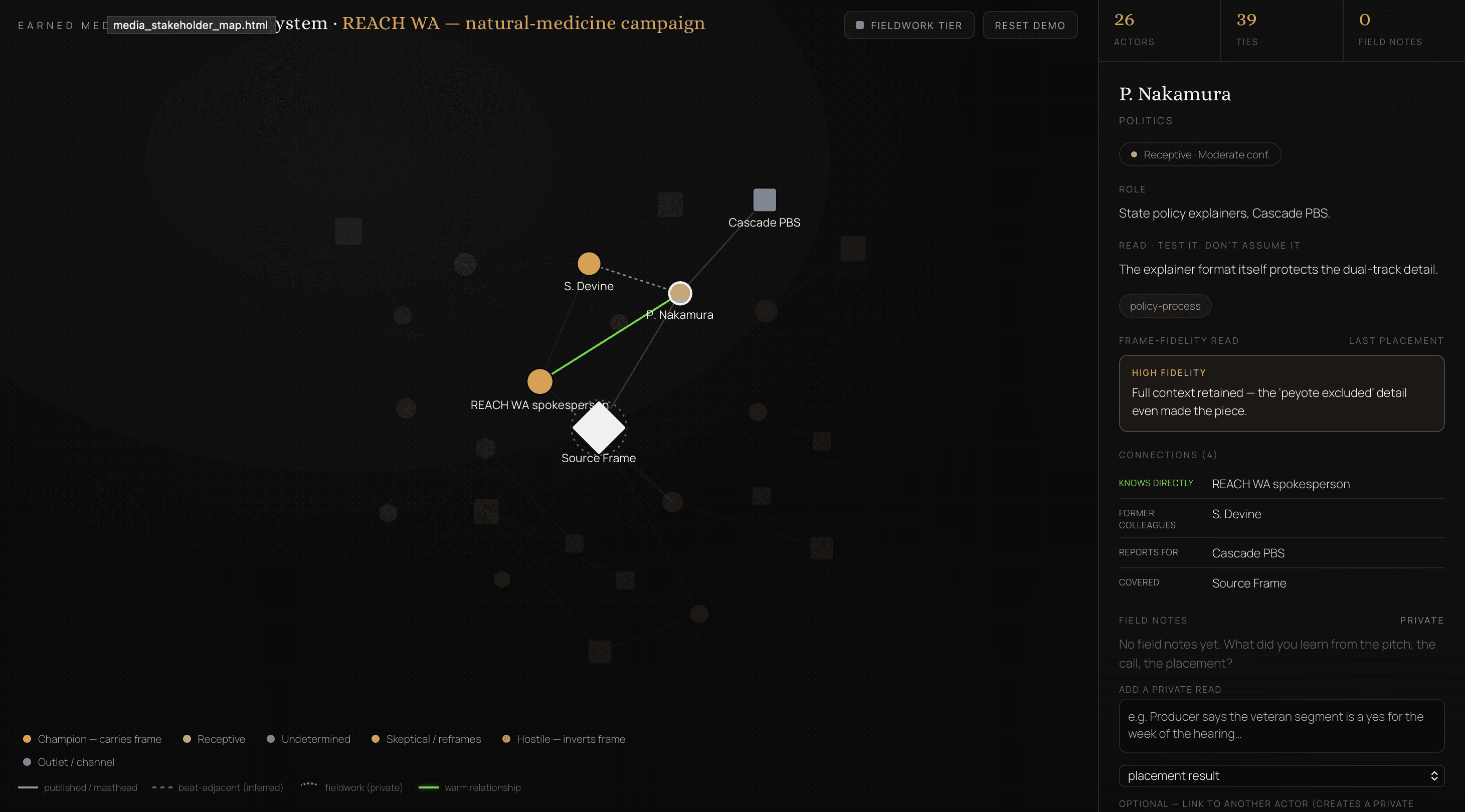
Images for reference only. Actual app user-interface may differ.
Coming soon
I'll have more to show shortly — the Strategic Primer first, then the lenses that share its foundation. If your work depends on reading a stakeholder landscape accurately and honestly, this was built for you.
— Town Squared Strategies (FKA Apex Action)
date published
Jul 8, 2026
reading time
5 min read